
Steel-tip vs. soft-tip darts: the differences
Category: Wissen
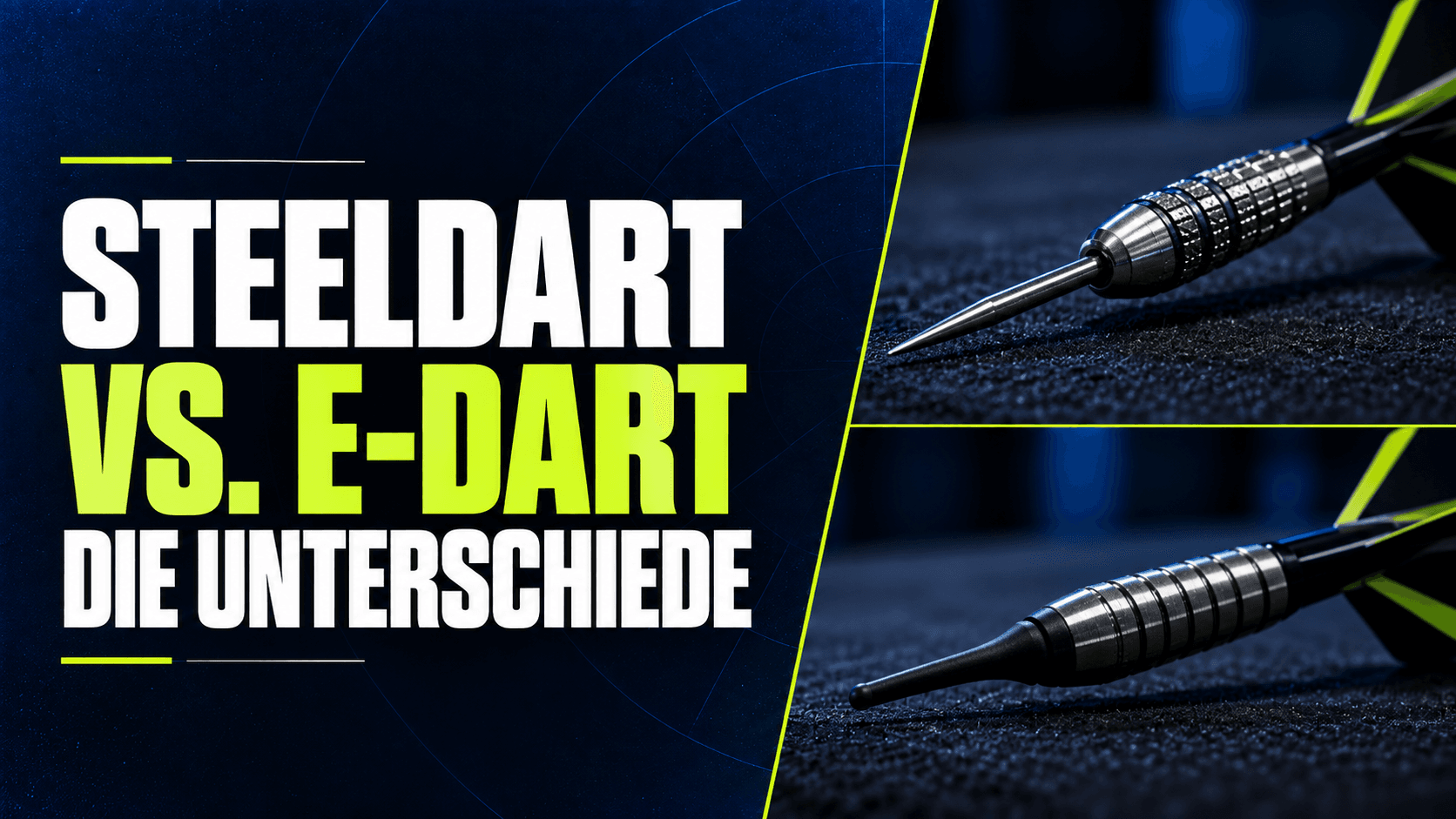
Steel-tip and soft-tip darts (e-darts) differ mainly in the board, the tips, the dart weight and the scoring: with steel-tip darts, metal points fly at a sisal board and you do the maths yourself; with e-darts, plastic tips hit an electronic machine that scores automatically. The dimensions are now largely identical – only a few associations such as the DSAB still play e-darts at 2.44 m.
Eckdaten
- Max. dart weight steel-tip: 50 g
- Max. dart weight soft-tip: 18 g
- Distance to the board: 2.37 m
- Bull's Eye height: 1.73 m
- Board material: Sisal vs. plastic
- Tip material: Steel vs. plastic
- Highest single hit: 60 points
- PDC founded: 1992
The basic difference: board and tips
The biggest difference lies in the material. With steel-tip darts the board is made of sisal fibres – simpler models are made of cork or paper – and you throw darts whose points are made of steel. With soft-tip darts, also called e-darts or machine darts, the board or machine is made of plastic with holes, and the points of the darts are plastic too. This also results in different wear: with e-darts, plastic tips keep breaking off and have to be replaced. With steel-tip darts, on the other hand, the dartboard usually has to be replaced after a few years, and a broken steel point can even mean buying a completely new set of darts. In principle you can also mix the materials: for soft darts there are screw-in steel points, known as conversion points. Incidentally, steel points should not be sharpened but rounded – that protects the board and the darts sit more firmly in it.
Dart weight and length: 50 grams versus 18 grams
In terms of rules, what mainly separates the two variants is the permitted dart weight. Steel darts may weigh up to 50 grams and be up to 30.5 centimetres long. In soft darts, most associations and machines usually set the weight limit at 18 grams, and the overall length should not exceed 16.8 centimetres – on some machines and in some associations the limit has since been raised slightly. The reason for the limit is technical: heavy darts and hard throws would damage the machine's matrix. So if you play with darts of 20 grams or more, the rules practically leave you with steel darts only – a common reason why soft darters switch to the steel variant sooner or later. Conversely, the 50-gram upper limit in steel darts is rather theoretical: in practice, common darts range from about 16 to 26 grams. The barrel material also plays a role. A distinction is made between brass, tungsten and nickel. The higher the tungsten content, the thinner the barrel can be made at the same weight – which allows tighter grouping on the board.
Scoring: mental arithmetic or display
In steel darts, a scorer adds up the points and works out the remaining score; the players themselves should also be good at mental arithmetic so they can decide which bed to aim at next. In e-darts, the machine handles the counting down completely and shows the remaining score on the display. Steel darts is therefore more mentally demanding and trains your mental arithmetic over time – if you just want to play in the pub in a relaxed way, you are better off with the machine. It also matters when a hit counts. In steel darts, the dart has to stay in the board until the score has been called out; if it falls out before that, the throw is scored as zero. In e-darts, the machine counts the points as soon as the tip touches the board – even if the dart slips out again afterwards. That changes the game tactically: in steel darts, a dart already in the board can block space, so players switch from the Triple 20 to the Triple 19, for example. In soft darts, on the other hand, you can in principle throw right at the darts already in the board, because the hole pattern straightens every dart out again.
Measurements and dimensions: almost identical today
In terms of dimensions, the two variants are now largely the same. The horizontal distance from the throw line (Oche) to the board is 2.37 metres – in soft darts, 2.44 metres officially applied until the end of 2015. The largest German e-darts association, the DSAB, still plays at 2.44 metres, while practically all other e-darts associations in Germany and internationally have switched back to 2.37 metres; the EDU European Championship was also played at 2.37 metres. A small difference remains in the height: the centre of the dartboard hangs 1.73 metres above the floor; according to the Deutscher Sportautomatenbund (DSAB), it is 1.72 metres in soft darts. On Löwen machines, the Bullseye is accordingly at 1.72 metres instead of 1.73 metres. Nothing changes on the board itself: 20 segments with the values 1 to 20, plus the green Single Bull worth 25 and the red Bull's Eye worth 50 points. The narrow inner ring (Triple) triples the value, the outer one (Double) doubles it – making the Triple 20 with 60 points the highest single hit, not the Bull's Eye.
Playing environment, costs and associations
E-darts machines are usually found in pubs and bars, because operators and landlords earn a share of the coin slot – e-darts is therefore available everywhere, but it costs money per game. Using a steel dart setup is normally free, but for steel darts there are far bigger regional gaps in Germany. The noise level differs too: the machine acknowledges hits with sounds, while in amateur steel darts more importance is placed on quiet and concentration. In terms of purchase costs, e-darts is cheaper: after the initial purchase, hardly any further costs arise apart from plastic tips. Because of the plastic tips, soft darts is also considered safer and is thus the obvious choice for households with children and for party players. Steel darts requires more space and care because of the sharp points. Both variants are organised in their own structures. The World Darts Federation (WDF) has more than 60 member countries; the Professional Darts Corporation (PDC), founded in England in 1992 by 16 professional players, is a pure pro league, represented in German-speaking countries by PDC Europe since 2006. In soft darts, the Deutsche Elektronik Dart Sport Vereinigung (DEDSV), the Deutscher Sportautomatenbund (DSAB) and the Deutscher Dart Sportverband (DDSV), among others, are active.
Which suits you better?
For beginners, children and party players, soft darts is the pragmatic choice: safe plastic tips, automatic scoring and plenty of game modes such as Cricket or 301 lower the barrier to entry considerably. The downside: the boards need mains power or batteries, and the plastic tips break. Steel darts, on the other hand, offers a genuine pro feeling without a power supply, long-lasting boards and darts and the direct feedback of darts sticking in the board – ideal for learning throwing technique and for anyone who wants to play in a club, at tournaments or “like at the World Championship”. Prize money is now also considerably higher in steel darts than in the electronic variant, because rising entry numbers bring higher appearance fees and prize money. If you can't decide, you don't have to: anyone who can play darts can basically do both. Top German players compete in both areas – depending on the difference in weight, throwing style and routine, switching over only takes a bit of getting used to.
Häufige Fragen
What is the main difference between steel darts and e-darts?
Steel-tip darts are thrown with steel points at a sisal board and scored by the players themselves. E-darts (soft-tip) are thrown with plastic tips at an electronic plastic machine that counts the points automatically.
How heavy may steel darts and soft darts be?
Steel-tip darts may weigh up to 50 grams and be up to 30.5 cm long. Soft-tip darts are usually limited to 18 grams and 16.8 cm to protect the machine's matrix – some machines and associations have since raised the limit slightly.
Is the distance to the board different in e-darts?
Usually not any more. The distance is 2.37 m; in soft-tip darts 2.44 m officially applied until the end of 2015. The DSAB still plays at 2.44 m, most other e-dart associations have switched back to 2.37 m. The Bullseye height is 1.73 m, in soft-tip darts 1.72 m according to the DSAB.
Does a dart that falls out of the board count?
In steel-tip darts, no – the dart has to stay in the board until the score is called, otherwise the throw counts as zero points. In e-darts the machine scores as soon as the tip touches the board, even if the dart falls out afterwards.
Which is better suited for beginners?
For beginners, children and party players, soft-tip darts are usually the easier start thanks to the safe plastic tips and automatic scoring. If you want to learn the technique properly, play in a club or compete in tournaments, steel-tip darts are the better choice.
Can you play both?
Yes. If you can play darts, you can generally play both variants – Germany's top players compete in both. All it takes is adjusting to the other dart weight, which some players find easier than others.