
The darts rules: 501 and X01 explained
Category: Wissen
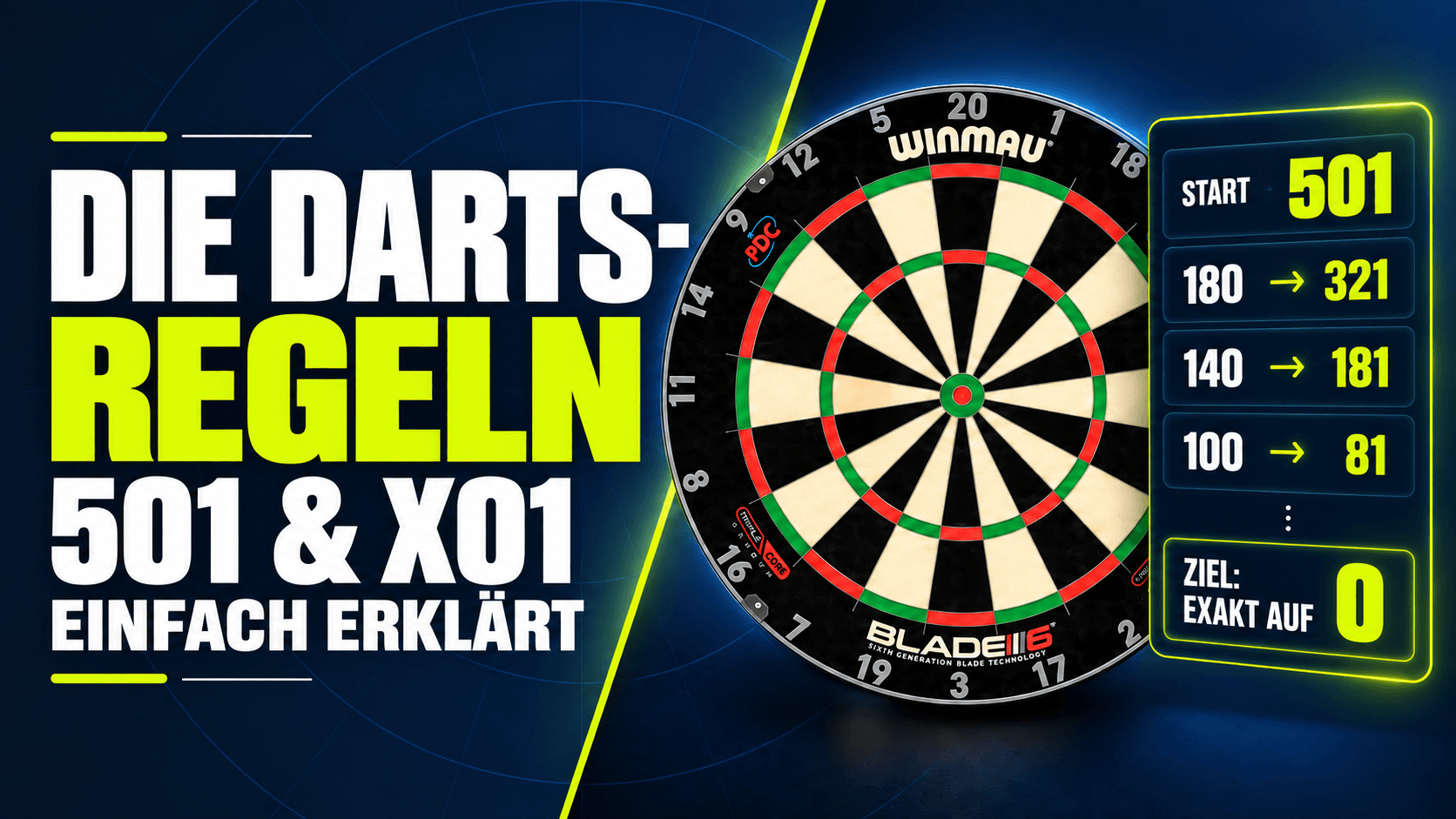
In X01 – the standard game in darts – every player starts with a fixed score (usually 501) and has to reduce it to exactly zero with accurate throws. The last dart has to land in a Double (Double Out).
Eckdaten
- Standard starting score: 501
- Darts per throw: 3
- Highest throw: 180 points
- Highest single hit: 60 points
- Highest finish: 170 points
- Perfect Leg: 9 darts
- Lowest Double: D1 = 2 points
- Distance Oche – board: 2.37 m
What is X01?
X01 is the classic and best-known game format in darts – played in pubs, in training and at practically every major tournament. The name stands for the respective starting score: 101, 301, 501, 701 or 1001. When people talk about “the darts game”, they usually mean 501. This variant is played in both the steel darts and the e-darts Bundesliga and is used at every World Championship. The aim is quickly explained: every player starts with the agreed score and subtracts the points they throw. Whoever reaches exactly zero first – while keeping to the Double Out rule – wins the Leg. Shorter variants such as 101 and 301 are suited to quick games and training matches, while higher starting values like 701 or 1001 are mainly played in teams or doubles.
Game start, visits and scoring
Before the first Leg there is a bull-up: both players throw one dart at the Bullseye, and whoever lands closer to the centre starts. In a deciding Leg, the players bull up again; in casual games a coin toss or a simple agreement is enough. A visit consists of three darts – unless the Leg, the Set or the match can be finished with fewer darts. The points of all three darts are added up and subtracted from the current remainder, then it is the opponent's turn. An example: start at 501, first visit 100 points → 401 left, then 85 → 316, then 140 → 176, and finally 96 finished on a Double → 0 left, Leg won. Important in practice: any dart that falls out of the board or bounces off may not be thrown again. A dart only counts if its point is stuck in the playing surface or touching it. If a player accidentally throws another dart even though the required Double has already been hit, those points do not count.
Double Out – the decisive throw
The double-out rule is the heart of X01: the final dart that ends the Leg must hit a Double. Doubles are the narrow outer rings of the number segments – plus the Bullseye, which counts as a Double and scores 50 points. So with 40 left, a hit in D20 ends the Leg; with 50 left it is the Bullseye. The lowest checkable Double is Double 1 with 2 points. Unless agreed otherwise, all competitions are played "straight in, double out": every dart counts from the start, but a Leg may only be finished on a Double. Deliberately hitting that last Double is regarded as the greatest mental challenge in darts. When checking out, a system pays off. As a rule of thumb, the Doubles that can be halved repeatedly are the most comfortable targets – in this order: D16, D8, D4, D2, D1, then D20, D10, D5, then D12, D6, D3, then D18, D9, then D14, D7 and finally the odd Doubles D11, D13, D15, D17 and D19.
The bust rule
A bust occurs when a player scores more points in a visit than they have left, or when they end up on a remainder of one point. In both cases the entire visit is cancelled: the player starts the next round again with the remainder they had before the visit. An example: with 32 points left a player hits D20 and scores 40 points – that is a bust, and the remainder stays at 32. A remainder of one point is just as unplayable, because no Double scores only one point. This rule forces you to plan your remaining points ahead instead of simply aiming for the highest fields.
Variants: Straight In, Double In, Master Out
Besides the standard combination, the way in and the way out can be varied. Straight In means starting on any field, Double In only allows opening on a Double – points thrown before that are void. With Master In, a hit on a Double or Treble is enough to open. On the finishing side: Straight Out allows finishing on any field, Master Out on a Triple or Double, Double Out strictly requires a Double as the last dart. In casual play and in practice, Straight In / Straight Out is often used, which makes getting started easier for beginners – but it removes the tactical demands of the finish. The Double In / Double Out combination is considered especially tough, because it demands maximum accuracy from the first visit to the last.
Scoring strategy, Legs and Sets
In 501 you score on the highest possible fields, that is Triple 20, Triple 19 or Triple 18. If darts already in the board block the view of a Triple, you switch to one of the other segments – a so-called cover shot. The highest throw with a single dart is 60 points (Triple 20, not the Bullseye); with three darts 180 points are possible. A Leg is a complete round from the starting score down to zero. Depending on the tournament format, several Legs are combined into a Set, and whoever first wins the required number of Sets decides the match. "Best of 5 Legs" means: whoever takes three Legs first wins. A match over two winning Sets is called "Best of 3", over three winning Sets "Best of 5". When writing on the scoreboard, the remaining points and the points scored stand next to each other. As soon as a player reaches the finishing range – that is, the range from 170 points, from which the Leg can be finished – both the score thrown and the previous remainder are crossed out to make it clearer.
Häufige Fragen
What does bust mean in darts?
A bust occurs when a player scores more points than they have remaining, or lands on a remainder of one point. The entire throw then doesn't count, and the player starts their next round with the same remainder as before.
Does the Bullseye count as a Double?
Yes. The Bullseye counts 50 points and is scored as a double. It may therefore be used to finish a Leg (Double Out) and to start with Double In.
Who starts a match?
The starting player is determined by a bull-off: both players throw one dart at the Bull, and whoever lands closer to the centre begins. In a deciding Leg, there is another bull-off.
What is the difference between a Leg and a Set?
A Leg is a single round from the starting score – 501, for example – down to zero. Several Legs make up a Set, and several Sets won decide the entire match.
Can you also play without Double Out?
In casual play, yes: with Straight Out you may finish on any field, with Master Out on a Treble or Double. Officially, however, almost everyone plays Double Out.
What is the highest possible finish?
170 points, thrown as Treble 20, Treble 20 and Bullseye. It is also the highest remainder from which a Leg can be finished with three darts.