
Dartboard dimensions: height, distance and mounting
Category: Wissen
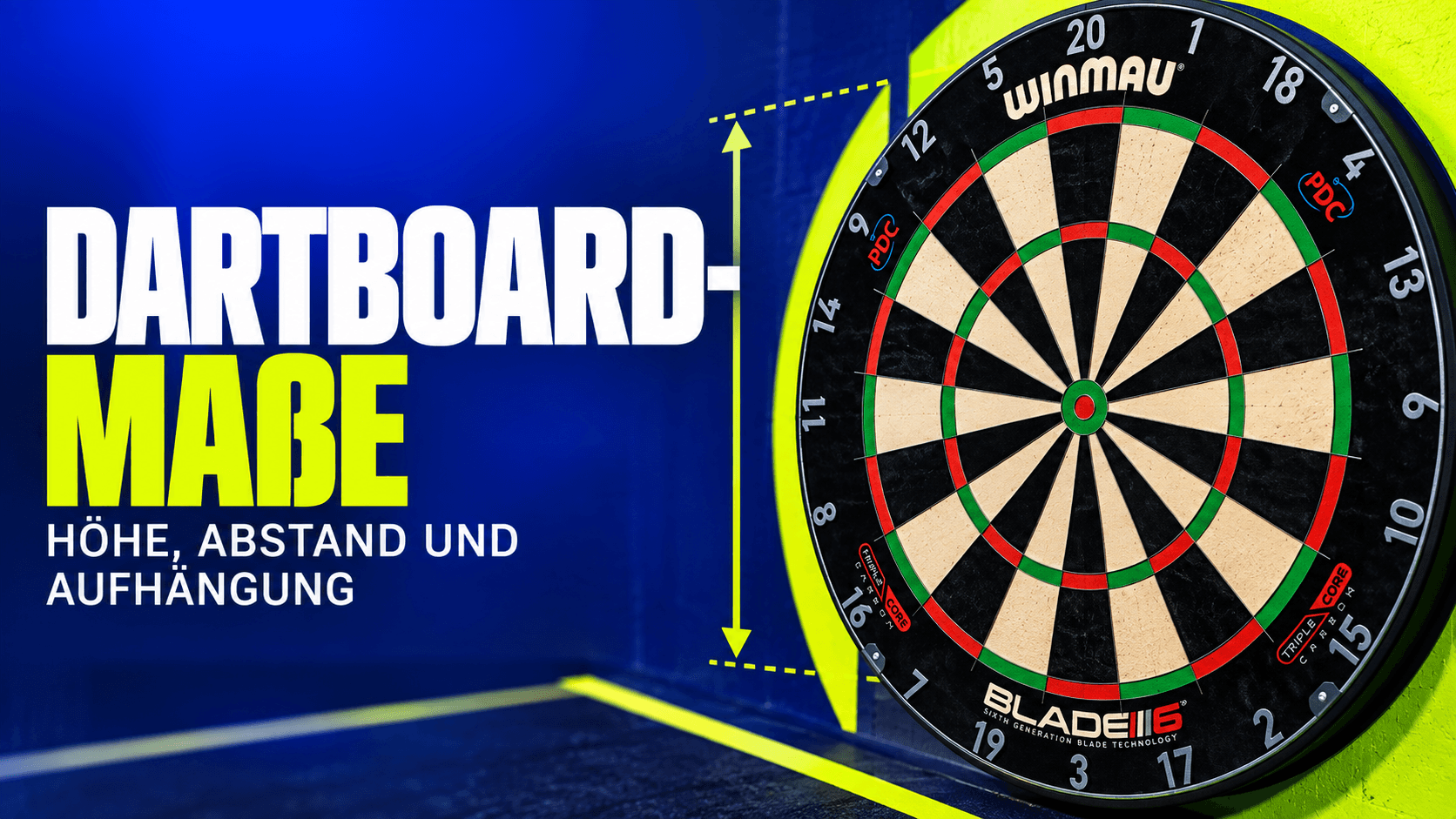
The centre of the Bullseye hangs 1.73 m above the floor, and the horizontal distance from the throwing line (Oche) to the board surface is 2.37 m. As a check, the diagonal between the centre of the Bullseye and the Oche must measure 2.93 m.
Eckdaten
- Bullseye height: 1.73 m
- Oche distance: 2.37 m
- Diagonal: 2.93 m
- Side distance to wall: min. 0.90 m
- Distance between two boards: min. 1.80 m
- Space behind the Oche: 1.22–1.25 m
- Wheelchair darts: 1.37 m
- Soft-tip darts until 2016: 2.44 m / 1.72 m
The height: 1.73 m to the centre of the Bullseye
The official height of a dartboard is 1.73 m, measured from the floor to the centre of the Bullseye. You always measure at a 90-degree angle to the floor. This measurement applies to steel-tip darts as well as – since standardisation – to soft-tip darts, and it is also used at professional tournaments such as the PDC World Darts Championship. If you stand on a dart mat or a carpet, you have to include its build-up height: with a mat 0.5 cm thick, the board hangs 173.5 cm above the floor, so that the relationship between the standing surface and the board is right again. Different values exist only in special cases. The Deutscher Sportautomatenbund (DSAB) states 1.72 m for its area, and the American Dart League hangs its boards at 5 feet 8 inches, i.e. 172.7 cm.
The distance: 2.37 m from the Oche to the board
The horizontal distance from the throwing line (Oche) to the dartboard is 2.37 m. What counts is where the foot stops at the throwing line – all measurements refer to the point where the foot touches the line. A common mistake when setting up: you measure to the surface of the dartboard, not to the wall behind it. If you measure from the wall, you quickly end up four to five centimetres too close – and depending on the board, spacer or darts machine, the difference is even bigger. The World Darts Federation sees 237 cm as the minimum throwing distance; the American Dart League gives a range between 7 feet 9¼ inches (2.37 m) and 8 feet (2.44 m). So standing further back is not forbidden, but it brings no advantage in training.
The 2.93 m diagonal as a check measurement
Height and distance can be cross-checked with a single measurement: the diagonal from the centre of the Bullseye down to the foot edge of the Oche must be 2.93 m. If this value is right, 1.73 m and 2.37 m are necessarily correct. The easiest way to measure is with a flexible tape measure at least 3 m long and with two people: one person holds the tape at the centre of the board, the other stretches it to the throw line. Alternatively, prepare a piece of string exactly 2.93 m long and fix it at the Bull. If you don't get to 2.93 m, the height or the distance needs adjusting.
Space needed around the board
Besides height and throwing distance, the German darts association (DDV) also defines the distances within the playing area. To the side, the centre of the Bullseye should be at least 90 cm away from a wall. If several boards hang next to each other, at least 1.80 m must be kept between two boards – again measured from Bullseye centre to Bullseye centre. Behind the throw line you need free space: the figures are at least 1.22 m according to the DDV, while Wikipedia states 1.25 m. These rules serve smooth play and safety – something worth bearing in mind at home too, if children or pets are in the room. At hobby level the Oche itself can be marked with tape, a self-adhesive throw line, a dart mat or a dart carpet. In an official playing area it must be at least 61 cm wide and between 3.8 and 6 cm high; a wooden beam is often used for this.
Hanging a dartboard: step by step
First mark a point on the wall at a height of 173 cm with a pencil. Then fix the metal plate of the supplied mounting set with the two longer screws so that the hole in the middle points upwards and the bottom edge of the hole sits flush with the mark. Next, screw the thick screw into the centre of the back of the board and tap the rubber caps into the three designated spots with a hammer. Finally, hang the board on the bracket and check the diagonal of 2.93 m. Wooden or concrete walls are best for mounting. Because darts can bounce off (bouncers), the board should not hang near windows or valuable objects.
Special cases: soft-tip darts, wheelchair and children
Until 1 January 2016, soft darts had its own measurements: 2.44 m distance, 1.72 m height to the centre of the Bullseye and, as a result, a diagonal of 2.98 m. Since then the variants have been aligned, so steel darts and soft darts are played with the same values today. For darts from a wheelchair, the board is hung lower: the centre of the Bullseye is then at 1.37 m. The throwing distance stays unchanged at 2.37 m – the height is the only thing that is adjusted. For children, the adjustment depends on age and body height. A recommended example is a distance of around 1.57 m and a hanging height of about 1.14 m, which also lets children pull their darts out of the board themselves. From a height of about 1.56 m, the standard measurements apply.
Häufige Fragen
How high should a dartboard hang?
1.73 m, measured at a 90-degree angle from the floor to the centre of the Bullseye. That applies to steel-tip and soft-tip darts, and at the PDC World Championship too.
How big is the distance to the dartboard?
2.37 m from the throwing line (Oche) to the surface of the dartboard – not to the wall. The PDC pros throw from this distance too.
How do I check whether my board hangs correctly?
Measure the diagonal from the centre of the Bullseye to the throwing line. If it comes to 2.93 m, the height and distance are right. Best done with a tape measure in pairs or with a prepared piece of string.
What are the dimensions of the dartboard itself?
The diameter is around 45 cm, the playing area 34 cm. The Double and Treble rings are 8 mm wide, the double bull 12.7 mm and the whole bull 31.8 mm. From the outer Double wire to the bull it is 170 mm, from the outer Treble wire 107 mm.
How much space do I need all around?
At least 90 cm to the side from the centre of the Bullseye to the wall, at least 1.80 m between two boards and 1.22 to 1.25 m of clear space behind the throwing line.
What happens if a player oversteps?
You may step on the throwing line, but not over it. In most cases a dart thrown while overstepping does not count; depending on the rules the player has to sit out a round. Repeated oversteppings count as unsporting behaviour and can lead to disqualification.