
The checkout table: all finishes from 170 to 2
Category: Wissen
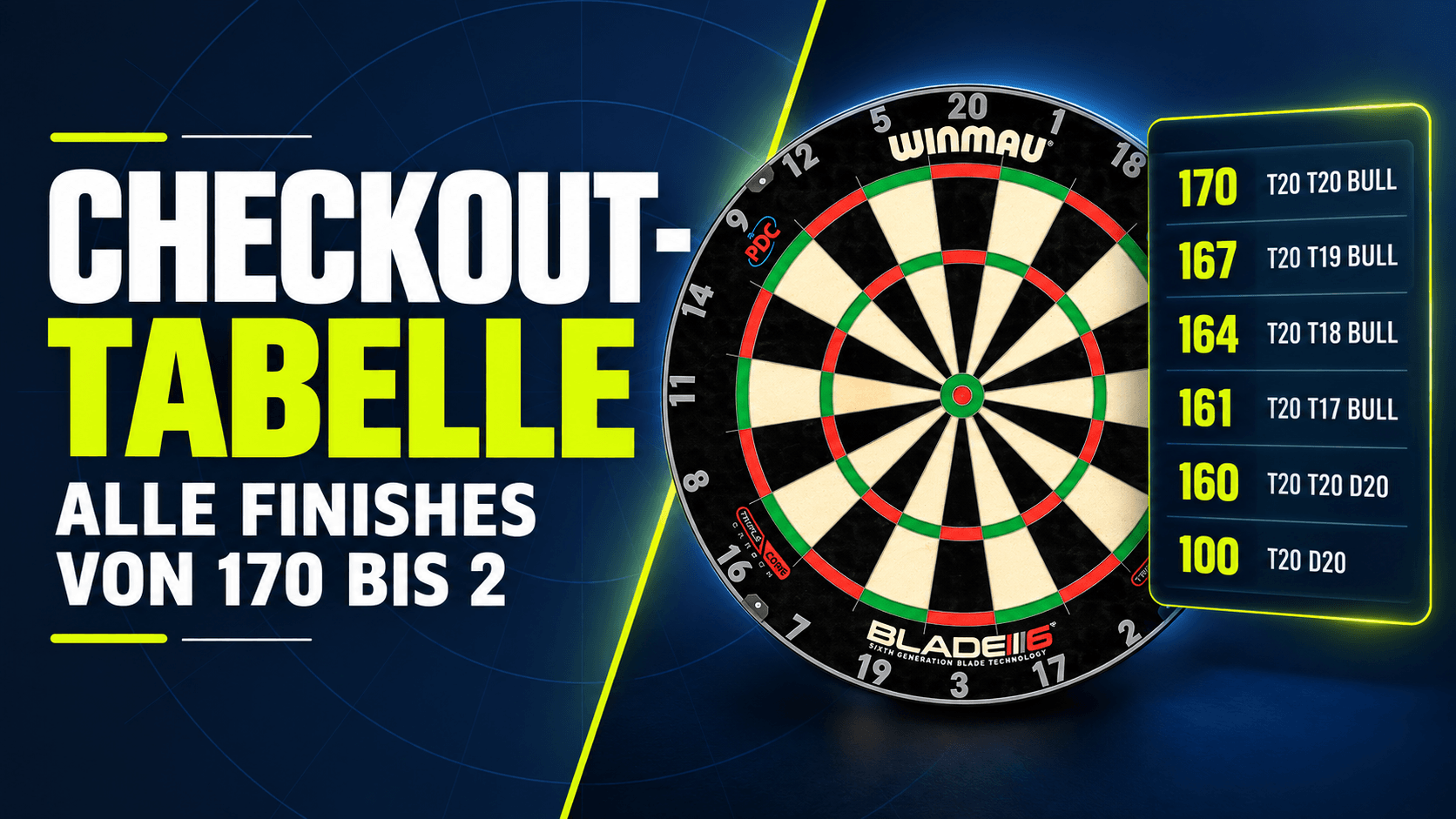
For every remaining score from 170 to 2, the checkout table shows which combination finishes a leg in double-out mode – 170 (T20-T20-Bullseye) is the highest possible finish. Only seven numbers below 170 cannot be thrown out with three darts at all: 169, 168, 166, 165, 163, 162 and 159.
Eckdaten
- Checkout range: 2 to 170
- Highest finish: 170
- Bogey numbers: 7
- Perfect leg: 9 darts
- Best double: D16
- Bullseye / Half Bull: 50 / 25 points
- Dream checkout: 32
- Calculation basis: Kari Kaitanen
What a checkout is – and why the table helps
A checkout is the score a player throws in their final visit at the oche, winning the leg with it. In the usual double-out mode (501, 301, X01), the last dart has to land in a double or in the bullseye. Checkouts from 2 to 170 are possible – all of them except seven numbers can be done with three darts. If you know your finishing routes, you don't have to recalculate after every dart but know straight away which field the next throw goes to. That makes for a steadier throwing rhythm and so raises your hit rate. That is exactly why no pro carries a slip of paper in their pocket: the combinations are known by heart. Bobby George sums up the importance of finishing: “Trebles for show and doubles for dough.” Worth knowing: for most remaining scores there are many ways to a double. Classic finish lists usually give only one route per score – the most common one. The Darts1 routes, for example, are based on the scientific calculations by Kari Kaitanen from “The Dart Book” (ISBN 951-96680-1-2) and are tailored to advanced players; for beginners and pros, other solutions can make more sense.
The highest finish and the seven bogey numbers
The highest checkout on a standard board is 170, affectionately called Big Fish in England. There is exactly one way to do it: Treble 20, Treble 20, Bullseye. Fallon Sherrock provided a prominent example at the 2021 Grand Slam of Darts: in a must-win leg to go through, the “Queen of The Palace” took out the 170 while her opponent was waiting on 68. Below 170 there are seven so-called bogey numbers that cannot be thrown out with three darts: 169, 168, 166, 165, 163, 162 and 159. Even world class doesn't change that – whether Phil Taylor, Michael van Gerwen or Gerwyn Price: these numbers are impossible to check with three arrows. Above 170 no finish is possible anyway, because three darts bring a maximum of 180 points, but the leg has to end on a double.
The table by ranges: from 170 to 2
From 101 up to 170 you normally need two Trebles or one Treble plus Bullseye. Typical routes: 170 = T20 T20 Bull, 167 = T20 T19 Bull, 164 = T20 T18 Bull, 161 = T20 T17 Bull, 160 = T20 T20 D20, 152 = T20 T20 D16, 141 = T20 T19 D12, 136 = T20 T20 D8, 120 = T20 S20 D20. Between 101 and 110 you mostly work with a Treble, a Single and a Double, for example 110 = T20 S18 D16 or 104 = T18 Bull. Between 91 and 100 a Treble and a Double are enough; two Singles will not leave you on a Double here. The standard routes are 100 = T20 D20, 98 = T20 D19, 96 = T20 D18, 95 = T19 D19, 92 = T20 D16. From 81 to 90 the same principle applies, and after a Single hit you can also finish via another Single and the D25 – for example 90 = T20 D15, 88 = T20 D14, 85 = T15 D20, 82 = Bull D16 or T14 D20. From 61 to 80 it depends on whether you still have three darts in hand or only two (80 = T20 D10, 76 = T20 D8, 68 = T20 D4, 65 = 25 D20, 61 = 25 D18). Between 41 and 60 you set up the Double with a Single (60 = S20 D20, 52 = S20 D16 or S12 D20). Below 41 every even number is a direct finish (40 = D20, 32 = D16); with odd numbers you first hit a Single that leaves the best possible Double (39 = S7 D16, 35 = S3 D16, 3 = S1 D1).
The second chance: why pros take different routes
The most important tactical idea is this: if I miss the Treble and only hit the Single, I still have to get a throw at a Double. Take 123 left: anyone throwing at the T20 and only hitting the S20 is left with 103 – no longer finishable with two darts. Start with the T19 instead and a Single leaves 104 points, which are still doable via T18 D25. If you hit the T19, you are on 66: here the T16 is smarter than the T10, because after T16 (D9 left) as well as after S16 (D25 left) you still get a dart at a Double. The same thinking explains a seemingly odd route: 77 can be played via T15 D16 – a nice Double. But if you only hit the S15, 62 is left (S12 Bull or T10 D16, both difficult). Via T19 D10, on the other hand, a Single 19 still leaves 58, so S18 D20. That is why the 19 route has the higher probability, even if the finishing Double is less popular. The unusual 79 = T19 D11 follows the same logic too: only this route guarantees that you stay below 61 points after the first dart and can therefore still set up a Double with two Singles.
Setting up the right double
Not every Double is equally good. Even Doubles are better than odd ones: if you throw at the D20 and only hit the S20, you can go straight for the D10. With the D19, on the other hand, after a Single you first have to hit another Single just to get on a Double at all. So a Double is the more valuable the more often it can be halved by Single hits while staying even. The ranking: the D16 can be halved four times, the D8 three times, the D20, D12 and D4 twice, the D18, D14, D10, D6 and D2 once – all odd Doubles (D19, D17, D15, D13, D11, D9, D7, D5, D3, D1) not at all. That is why 32 (D16) is the remaining score every darts player wishes for. On top of that come personal preferences: Gary Anderson likes finishing on the D20 best, Mensur Suljovic's favourite Double is the D14. Technically, by the way, all Double segments are the same size – the only exception is the inner Bullseye. Another practical tip: when throwing at a Single, pick a field where an accidental Treble hit does not lead to a bust – with 60 left you therefore deliberately aim high at the S20, because the T20 ends the visit.
Middle game: avoid bogey numbers in advance
Ambitious players think about the route long before the finishing range. The so-called middle game means scoring down in such a way that a combination is left at the end – and none of the seven bogey numbers. A textbook example is 303 left. A 180 leaves 123, so a clean finish. But if you miss a Treble and hit a plain 20, a maximum of 140 is possible – 163 left, a bogey number. Top players therefore switch to the T18: two hits bring 195, and the Single Bull then sets up 170. And if one dart only lands in the S18, 230 is left – then the T20 leads back to 170. For this kind of arithmetic it helps to think of the segments by their final value (so '57' instead of 'Treble 19') and to know the multiples of the cricket numbers: 4x19 = 76, 5x19 = 95, 6x19 = 114, 7x19 = 133 or 6x18 = 108, 7x18 = 126.
Häufige Fragen
What is the highest finish in darts?
170 points, the so-called Big Fish. There is only one single way to do it: Treble 20, Treble 20, Bullseye.
Which numbers cannot be checked out with three darts?
The seven bogey numbers 169, 168, 166, 165, 163, 162 and 159. They are below 170 but still cannot be checked out with three darts.
What do T, D, S, Bull and 25 mean in the table?
T stands for Treble, D for Double, S for Single (single segment), Bull for the Bullseye (50 points) and 25 for the Half Bull or Single Bull (25 points).
Which Double should I leave myself?
Ideally D16: it can be halved four times, followed by D8 (three times) as well as D20, D12 and D4 (twice). Odd doubles such as D19 or D11 cannot be halved at all and are therefore tactically the weakest.
Is the Scorer allowed to tell me how to finish?
No. The rules forbid the scorer or referee to name a finishing route. But you may ask at any time how much you have scored or how much is left. The referee calls out the remaining score before the throw if it can be done with a maximum of three darts – so with 32 left, no “Double sixteen” is called.
How many darts do you need at minimum for a 501 Leg?
Nine darts. A classic variation is 180, 180, 141 – two maximum visits and a 141 finish.
Does Double Out always apply?
In steel-tip darts, Double Out is the standard. Soft-tip darts additionally offers the Master Out variant, in which a game can also be finished on a treble.