
Double Out, Single Out, Master Out: the checkout types
Category: Wissen
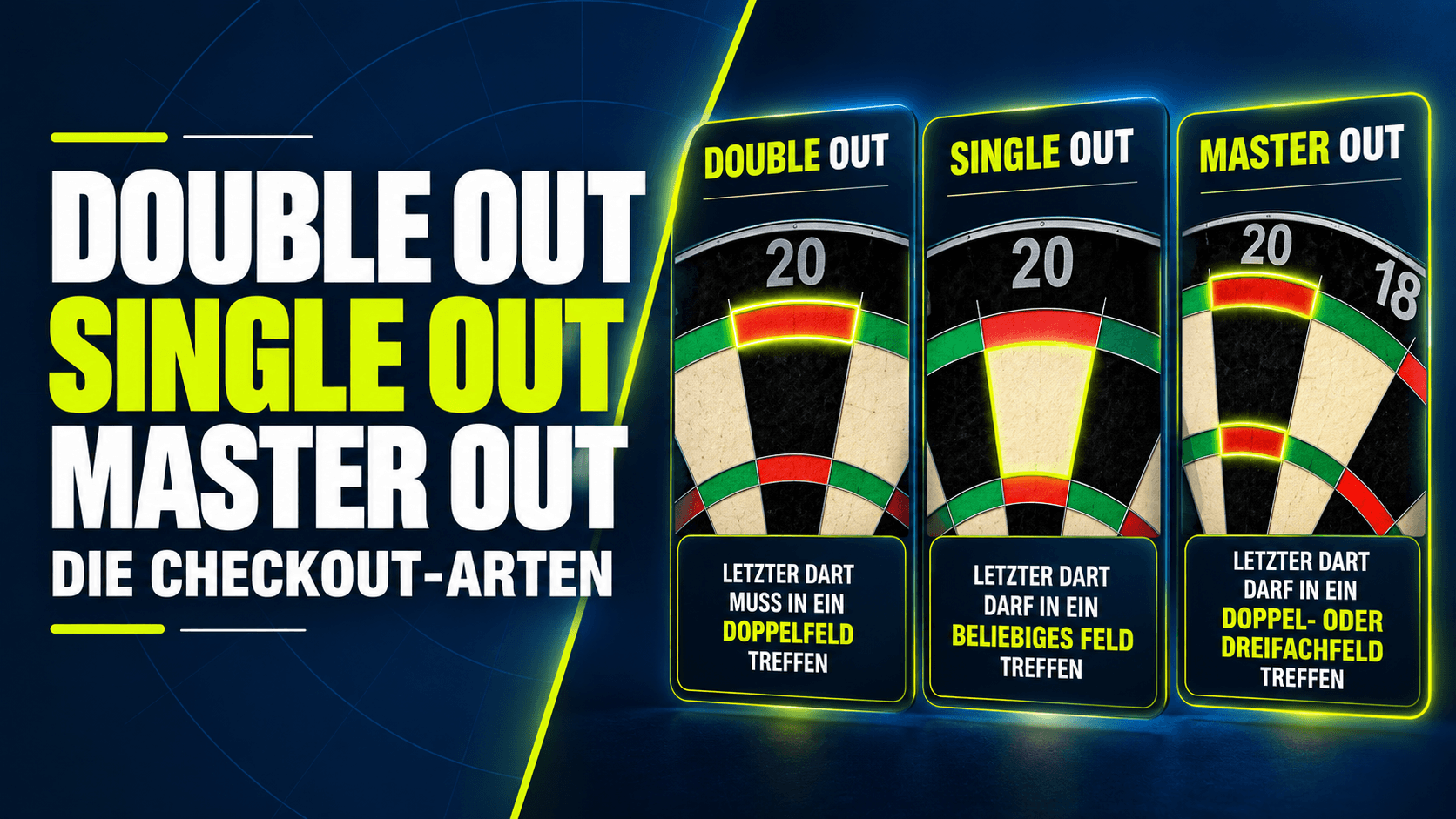
At the checkout it is the out rule that decides which field may end a leg: Double Out requires a double, Master Out allows a double or a treble, and with Single Out (Straight Out) any valid field ends the leg. Double Out is the standard in steel-tip darts, while Master Out and Single Out are found mainly in soft-tip darts.
Eckdaten
- Double Out: Double only
- Master Out: Double or Treble
- Single Out: any segment
- Tournament standard: 501 Double Out
- Highest Double Out finish: 170
- Highest remaining score on one dart (Master Out): 60
- DSAB E-Dart: A league Single, B league Master Out
- Outchart basis: Kari Kaitanen, "The Dart Book"
What "out" means in darts
The terms in and out describe how a leg has to be started and finished. In the classic X01 modes (501, 401, 301) the aim is to reduce the starting score to exactly 0 by hitting the segments on the board. The out rule determines which field the final dart may hit to do so. Straight In or Out allows you to start or finish on any segment. With Double In or Out, the first or last dart has to land in a double. With Master Out, a leg can additionally be finished with a hit in a treble. Triple In, by contrast, only allows a start with a treble hit – a double is not enough here. Important for all variants: if a player throws a score higher than their remaining score, the whole visit does not count (bust). They start their next visit on the score they had before the bust.
Double Out: the tournament standard
With Double Out, the last dart has to hit a double. The Bull's Eye (inner bull, 50 points) may be used to finish a leg, because it counts as a double – the same applies to Double In at the start of a game. The single bull with 25 points, however, does not count as a double. The most common tournament format is 501 Double Out: players have to clear the 501 points as quickly as possible and must finish on a double. This creates a tactical element around the final double and the route to it. In steel-tip darts only Double Out is played; in the DSAB, double out does not apply from the A-Liga onwards in soft-tip league play – there the A-Liga finishes on a single. The finishing routes for Double Out are well researched. The Darts1 outchart is based on scientific calculations by Kari Kaitanen, published in "The Dart Book" (ISBN 951-96680-1-2), and shows the routes with the highest hit probability for advanced players. Examples: 170 = T20-T20-Bull's Eye (the highest possible finish), 100 = T20-D20, 40 = D20.
Master Out: a double or treble ends the leg
Master Out is a checkout rule from soft-tip darts. A leg may only be finished on a double or a treble – a single is not allowed as the last dart. In the DSAB, Master Out is played in the B-Liga. The treble opens up completely new options and clearly changes the setup routes compared with Double Out. Below 60 points the routes are often fundamentally different: on 50 left, S10 into D20 goes out, or T10 directly; on 41 left, S9 into D16, or T13 directly; on 38 left, D19 directly (a single 19 as the last dart would be invalid). On odd remainders, T13, T15, T17 or T19 offer direct ways out. Scores that cannot be done in one dart with Double Out also become playable on a single arrow: 120 = T20-T20, 117 = T19-T20, 60 = T20, 57 = T19, 48 = T16. The Master Out checklist from Darts1 chose the routes so that, even if you slip into a single or a neighbouring field, you still get a chance at the checkout as often as possible. Master Out does not apply in steel-tip darts – the standard there is Double Out.
Single Out (Straight Out): every field counts
Single Out, also called Straight Out, is the simplest variant: a leg may be finished on any segment, no double is required. If the last dart hits a valid segment with exactly the remaining score, the leg ends immediately – including via single segments and the single bull. So with 25 or 50 remaining, the single bull can finish the leg. Tactically this often leads to direct routes via the big single segments, because no double is needed. Single Out is more forgiving of misses, and routes can be chosen more conservatively. If the target segment is blocked, you pick alternative big segments. A common misconception is that Single Out is always easier – the finish is easier, but scoring and setups remain decisive. Likewise, the bull is not a must but an option; big single segments are often the more reliable choice. Single Out is played above all in recreational and league soft darts – in the DSAB, for example, in the A-Liga. Beginners in particular often play Straight In and Out at the start because of the difficulty, which is then simply called 501/301/X01 without any addition.
Which variant when? Practice and route choice
Steel darts and all major tournaments: Double Out, usually as 501 Double Out. Soft darts: depending on the rules, Single Out, Master Out or Double Out – in the DSAB you finish on a single from the A-Liga upwards, while in the B-Liga Master Out applies. The respective rules determine the finishing variant, so it is worth looking at the league regulations before your first match. Every variant has its own outcharts. For Double Out the classic outchart is recommended, for Master Out the Master Out checklist – with small remaining scores the routes are sometimes fundamentally different. To learn them you can work with flashcards or position the outchart overview so that you can glance at it often. A tip for advanced players: it makes sense to look at the individual segments of the dartboard with their already multiplied final value, so not to speak of a Treble 19 but of the segment worth 57. It is also important to know the values of all double and treble segments and to understand why exactly these combinations make sense.
Häufige Fragen
What is the difference between Double Out and Master Out?
With Double Out the finish must be a double. With Master Out, doubles or trebles are allowed as the finish, but singles are not.
Does the Bull's Eye count as a double?
Yes. The Bull's Eye (inner bull, 50 points) counts as a double segment and may be used with Double Out to finish a leg and with Double In to start. The single bull (25 points) does not count as a double, but with Single Out it can finish the leg.
Does Master Out apply in steel darts?
No. The standard in steel darts is Double Out. Master Out is mainly used in soft-tip darts – in the DSAB in the B league.
What is the advantage of Single Out?
No double required: conservative finishing routes via big single segments are possible, and misses are more forgiving. But scoring and setups remain decisive.
Which variant should beginners play?
Because of the difficulty, beginners often play Straight In and Out at the start, which is then simply called 501/301/X01 without any addition. The tournament standard 501 Double Out pays off as soon as your scoring gets more stable.
What happens if you bust?
If a player scores more points than their remaining score, the entire turn does not count. They start their next turn with the score they had before busting.